
Our firm studies retirement markets the way an investor studies a balance sheet: methodically, patiently, and with a specific set of conditions we’re looking for before we make a call. We track wealth demographics and healthcare investment. We look at tax policy and infrastructure momentum. We watch for the moment when a city stops being a place people are moving to and becomes a place people cannot afford to leave behind.
McKinney has been on our list for a long time. And what we’re seeing right now tells us the moment is here.
Here is what the data shows, and why we believe McKinney, Texas, is one of the most compelling retirement destinations in the Dallas-Fort Worth Metroplex.
Why Is McKinney Considered Financially Strong?
McKinney is the fastest-growing city in the U.S. that most of the country still doesn’t know by name. Its 2026 population is approximately 243,500, up more than 23% since 2020, with 13,000 new residents added in 2025 alone. And yet, despite that growth, McKinney earned the #1 Most Affordable City in the United States ranking from Motley Fool Money in 2025, with a cost-of-living index of 97.5 (three points below the national average) and the highest income-to-expense ratio of any city in the country.
The median household income stands at $124,215. Collin County, where McKinney serves as the county seat, ranks among the top three wealthiest counties in Texas. The poverty rate is just 4.4%. These are not projections; they are the current reality of a community that has been building its wealth foundation for years while the rest of the Metroplex was watching other suburbs.
That foundation matters for retirees in a specific way: a wealthy, fiscally strong community funds superior public services, maintains infrastructure, and sustains quality of life for decades. McKinney is not coasting. It is building.
What New Development Is Coming to McKinney?
In 2025, McKinney posted $1.5 billion in total construction value, a record year driven largely by non-residential investment. The city issued 1,639 single-family building permits. New master-planned communities are reshaping north McKinney from the ground up.
Painted Tree is a nature-forward community built around 200 acres of open space, 25 miles of trails, and a 20-acre stocked fishing lake: think national park amenities, steps from your front door. Trinity Falls, a 2,000-acre master-planned community along the East Fork of the Trinity River, is one of the few communities in North Texas purpose-built for every life stage, including a Del Webb active adult section for 55-plus residents. Honey Creek spans 1,648 acres. Huntington Park covers 785 acres.
And sitting at the center of it all is Long Branch, a $1.3 billion, 155-acre walkable mixed-use district approved by McKinney City Council in 2025. When complete, it will deliver 1,600 homes, 135,000 square feet of retail anchored by a specialty grocer, a 318,600-square-foot office campus, a 100-room hotel, and a central park designed around pedestrian life. This is the kind of investment that changes the identity of a city, and the developers making it have done their homework.
Where Do McKinney Residents Shop and Dine?
For years, McKinney was a city where residents drove elsewhere to shop. That is changing, fast.
West Grove, the 52-acre mixed-use development at U.S. 380 and Custer Road, is now open, anchored by McKinney’s first Whole Foods Market (45,000 square feet), 420 luxury apartments, 55,000 square feet of office space, an open-air central park, and a curated lineup of restaurants, retailers, and service tenants. A Kroger Marketplace is set to anchor a second major mixed-use development at Frontier Parkway and Custer Road.
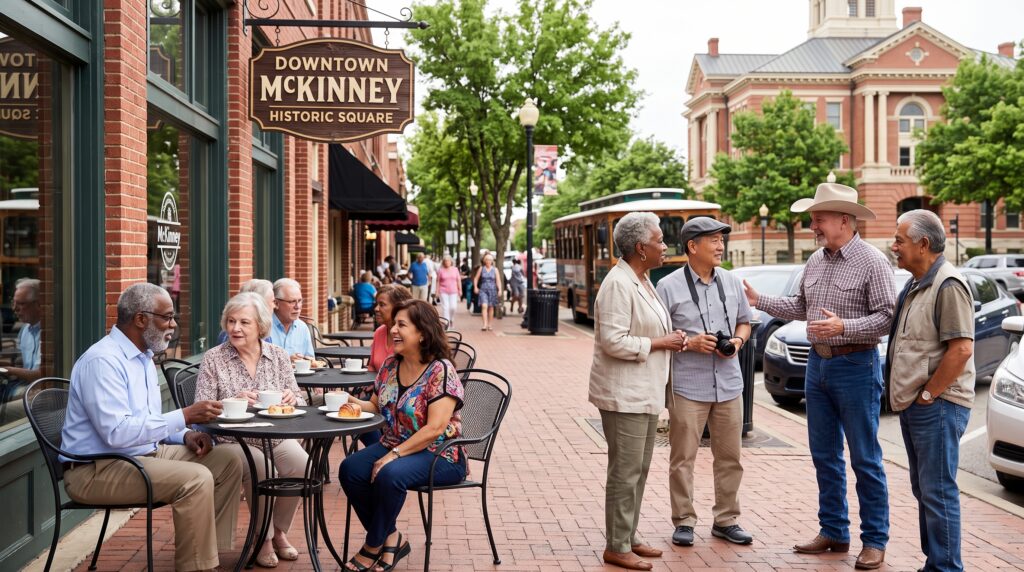
Meanwhile, Historic Downtown McKinney, one of the oldest thriving historic downtowns in Texas, offers more than 120 independently owned boutiques, art galleries, antique shops, and over two dozen restaurants and cafés, all set against beautifully preserved 19th-century architecture. This is daily life that most suburbs can only aspire to.
What Hospitals Are in McKinney, TX?
Healthcare access is the non-negotiable for retirement planning. McKinney delivers at a level that is exceptional for a suburban city of its size.
Baylor Scott & White Medical Center is a Level II Trauma Center, Level III NICU, and Level III Maternal Care facility, currently undergoing a vertical expansion that will add up to 100 new beds and 84,000 square feet to the hospital, with construction running through 2028. Medical City McKinney, a 318-bed hospital named to Healthgrades’ 2025 America’s 250 Best Hospitals list, operates a dedicated women’s hospital and serves more than 850 physicians. Methodist McKinney Hospital holds the Joint Commission Gold Seal of Approval for Advanced Hip and Knee Care.
And at the northeast corner of Central Expressway and Laud Howell Parkway, a 68-acre site has been rezoned for a future 12-story Texas Health hospital, a regional medical campus with an ER, surgical suites, women’s services, and a planned capacity of 300 beds. Three hospital systems operating today. A fourth on the way. For most retirees, that means the vast majority of medical needs, from routine care to complex procedures, are handled without leaving McKinney.
What Is the Retirement Lifestyle Like in McKinney?
TPC Craig Ranch, a private championship golf course designed by Tom Weiskopf, ranks among Golf Digest’s top courses in Texas and hosts the CJ CUP Byron Nelson PGA TOUR event each spring. After a $22 million renovation, it is considered one of the finest private golf experiences in North Texas. McKinney also maintains 3,000 acres of parks and open spaces across the city, with 80 miles of hike and bike trails.
The Heard Natural Science Museum’s 289-acre wildlife sanctuary provides a natural oasis within the city. And in September 2027, the VENU Sunset Amphitheater, a $220 million, 20,000-seat open-air venue at U.S. 75 and SH 121, will open as one of the most ambitious music venues in the South, featuring luxury fireside suites, The Aikman Club (in partnership with Troy Aikman and EIGHT Beer), covered seating, and gourmet food and beverage throughout. The economic impact over its first 10 years is projected at over $3 billion.
How Much Can Retirees Save on Taxes in McKinney?
Texas has no state income tax. Every dollar of your Social Security, 401(k) distributions, IRA withdrawals, pension, and annuity income is free from state taxation. For a household drawing $150,000 to $200,000 in annual retirement income, that can represent $12,000 to $25,000 or more in annual savings compared to high-tax states.
Collin County offers Over-65 property tax exemptions, and all Collin County school districts are required to extend the exemption to qualifying seniors. McKinney’s cost-of-living index of 97.5, below the national average despite being one of the premier suburban addresses in North Texas, compounds the tax advantage into one of the strongest total financial environments for retirees in the country.
What Senior Living Options Are in McKinney, TX?
McKinney has quietly become one of the most senior-friendly cities in the Metroplex. Community Impact documented 32 senior living communities in McKinney as of late 2025, spanning independent living, assisted living, memory care, and skilled nursing.
Del Webb at Trinity Falls delivers the active adult lifestyle within a master-planned nature community. Artistry at Craig Ranch, Mera Craig Ranch, Watermere McKinney, Village on the Park, and Hidden Springs of McKinney round out an array of options across every care level and price point. There are 15 active 55-plus rental communities in McKinney with units available today. Whether a retiree is purchasing a luxury home in Craig Ranch, downsizing to a patio home in Honey Creek, or transitioning into a resort-style independent living community, McKinney has built the infrastructure to meet them where they are.
Our Assessment: Why McKinney Stands Out for Retirement
We have been watching McKinney carefully for years, tracking the healthcare investment, the development approvals, the retail anchors, and the wealth demographics that tell us a community is preparing for the next chapter. The data has been building toward the same conclusion for some time.
McKinney is affordable without sacrificing quality. It is growing without losing its character. It has the healthcare depth, the lifestyle infrastructure, the tax environment, and the senior living options that give retirees a genuine, lasting advantage.
The city calls itself “Unique by Nature.” We think that motto understates the case.
If you’re thinking about what retirement in McKinney could mean for you, financially, logistically, or personally, we would genuinely welcome that conversation. It is exactly what we do, and exactly why we are here.