
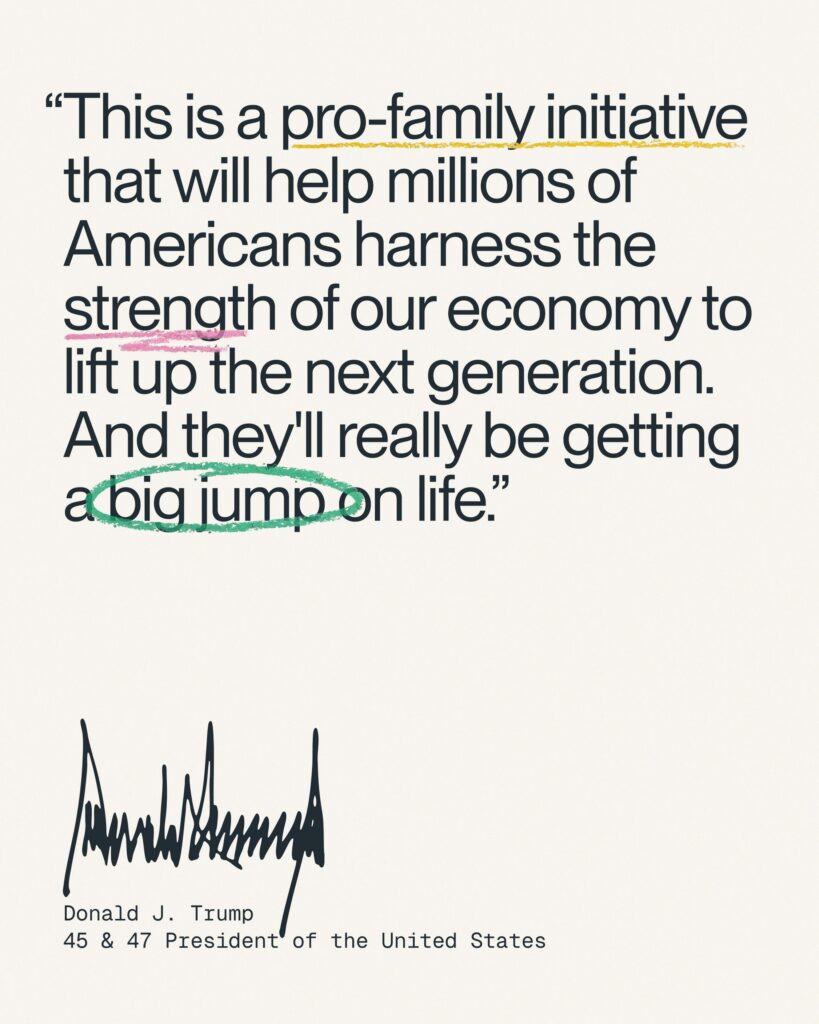
A quiet truth in family wealth planning is that time is the most powerful asset a child can have. When money is invested early—years or even decades before adulthood—compound growth can do what no last-minute scramble ever can.
That’s why the new Trump Accounts have drawn so much attention: they’re designed to give children an investing head start with a government seed deposit, plus a structured way for families (and even employers) to add more over time. Here’s what they are, how they work, and how to think about them alongside the traditional tools families have used for generations.
What is a Trump Account?
According to the IRS, a Trump Account is a type of traditional IRA designated as a Trump account, and the Secretary (Treasury) creates/organizes the “initial Trump account” for each eligible individual, with the parent/guardian making the election. IRS+1
Practically speaking, it’s built to do three things:
- Start early (potentially at birth),
- Invest in broad U.S. equity markets, and
- Delay taxation while money grows, then transition into traditional IRA-style rules once the child reaches adulthood. IRS+1 Unlike a traditional IRA contribution, contributions to a Trump Account generally aren’t deductible.
The headline feature: the $1,000 government seed deposit (pilot program)
Under the pilot program described by the IRS, the federal government will make a one-time $1,000 contribution for eligible children who are U.S. citizens born from January 1, 2025, through December 31, 2028(assuming a Trump Account election is made for the child). IRS+1
This is the part families understandably notice first: it’s rare to see any program that effectively “opens the investing clock” at the starting line.
There have also been high-profile philanthropic commitments to fund additional children (outside the federal seed window), which is driving even more awareness. Reuters
When do Trump Accounts actually start?
One important timing note: Contributions can begin no earlier than July 4, 2026 (with public rollout messaging pointing to July 5, 2026.
While families may hear about Trump Accounts “coming in 2026,” the operational detail that matters is: don’t expect to fund them until mid-2026.
Who can open one, and for whom?
The IRS describes Trump Accounts as available for a child who:
- Has not turned 18 before the end of the calendar year in which the election is made, and
- Has a valid Social Security number. IRS
To receive the $1,000 pilot seed deposit, the child must also be a U.S. citizen and born between 2025 and 2028. IRS+1
In other words, there are really two layers:
- Account eligibility (minor with SSN), and
- Seed money eligibility (citizen + birthdate window).
Contribution rules: what families (and employers) can add
The IRS guidance lays out several ways money can enter a Trump Account:
1) Family and friends
Other individuals can contribute up to an aggregate limit of $5,000 per year (indexed for inflation and adjusted after 2027). IRS
2) Employer contributions
An employer may contribute up to $2,500 per year to a Trump Account of an employee or the employee’s dependent, and the contribution does not count toward the employee’s taxable income—but it counts against the $5,000 annual limit. IRS+1 The $5,000 annual limit applies to regular contributions (including employer contributions), but the $1,000 pilot deposit and qualified general contributions don’t count against that limit. The $2,500 employer cap is generally applied per employee per year, not per child.
3) Governmental entities and charities
Certain governmental entities and charities may make “qualified general contributions” to Trump Accounts if given to a qualified class of beneficiaries. IRS
Planning takeaway: if you have a household with strong cash flow, the account’s design encourages consistent annual funding—and if an employer participates, it can meaningfully accelerate the compounding.
Investment rules: simple by design
During the child’s early years, Trump Accounts aren’t meant for stock picking or complex strategies. The IRS says the funds must be invested in certain mutual funds or ETFs that track the S&P 500 or another primarily U.S. equity index, subject to limits like no leverage and very low fees.
That limitation may sound restrictive, but it also keeps the account aligned with a classic long-term approach: broad-market exposure, low complexity, and the patience to let time do its work.
Withdrawal rules: this is not a “kid spending account.”
Trump Accounts are intentionally not built for early withdrawals.
The IRS guidance states that amounts generally cannot be withdrawn before January 1 of the calendar year the child turns 18. Distributions are prohibited during the growth period except in limited circumstances(e.g., certain rollovers, excess contributions, death). After that point, the account is generally treated as a traditional IRA, subject to the rules that apply to traditional IRAs. IRS+1
That means:
- Before 18: think “hands off.”
- After 18: think “retirement-account rules,” including the reality that early IRA withdrawals can create taxes and potential penalties depending on the circumstances.
Planning takeaway: Families should view this as a long runway tool. If your main goal is to pay for college tuition in 5–15 years, a Trump Account may be only one piece of the plan—not the whole plan.
How might this fit alongside the tried-and-true options?
Families already use a handful of “classic” tools to build generational momentum. Trump Accounts don’t replace these automatically; they sit alongside them. Here’s a practical way to compare:
529 plans (education-focused)
- Best when the primary goal is education funding (college, and in many cases, K-12/private school rules depending on your situation).
- Typically offers tax advantages when used for qualified education expenses.
- More purpose-built for tuition than Trump Accounts.
UTMA/UGMA custodial accounts (flexible, but with control tradeoffs)
- Flexible spending purpose, but the child receives legal control at the age of majority (often 18 or 21, depending on the state).
- May impact financial aid considerations and creates a “hand the keys over” moment that some families dislike.
Roth IRA for kids (requires earned income)
- Potentially powerful for young workers, but only if the child has earned income.
- Trump Accounts do not require earned income (a significant structural difference), which is why they can begin much earlier. Schwab Brokerage+1
Where Trump Accounts may shine: households who want a simple, equity-indexed, long-term account that starts early, has clear guardrails until adulthood, and may include a government seed deposit for eligible children. IRS+1
What could long-term compounding look like?
Government estimates and financial-firm illustrations vary, but the point is consistent: starting at birth can create surprisingly large numbers later.
For example, a Council of Economic Advisers document modeled scenarios under market-return assumptions and showed that outcomes can diverge dramatically depending on whether families make maximum contributions or none at all. The White House
The lesson isn’t the exact projection—it’s the principle: small, steady contributions over many years can become a meaningful foundation.
Practical “family playbook” for using Trump Accounts wisely
If you’re considering these accounts for your children (or grandchildren), here’s a sensible, traditional approach:
- Start with the purpose. Is this money meant for education, a first home, a future business, or retirement security? The purpose should determine which accounts receive priority.
- Capture the seed money if eligible. If your child qualifies for the $1,000 pilot deposit, treat that election as a “don’t-miss” item on the family checklist. IRS+1
- Automate contributions—consistency beats intensity. A monthly contribution rhythm is often easier than trying to remember a lump sum at year-end.
- Coordinate with your employer’s benefits team. If employer contributions are available, they may be among the most efficient accelerators (and are explicitly contemplated in IRS guidance). IRS
- Keep expectations realistic and diversified across goals. A Trump Account is not automatically “the best” tool for every goal. Many families will still use 529 plans, IRAs for working teens, and disciplined taxable investing as part of an overall family strategy.
A final word of caution (the wise kind)
Trump Accounts are new. The IRS has issued initial guidance, notingIf that regulations and operational details are still developing. IRS
So, treat this as the way careful families treat any new planning tool:
- Learn the rules,
- Coordinate with your tax and financial professionals, and
- Ensure the account selection aligns with the family’s values and long-term priorities.
If you are looking for more claification please reach out to our office.
Disclosures
The sources used to prepare this material are believed to be true, accurate, and reliable, but are not guaranteed. This information is provided as general information and is not intended to be specific financial or tax guidance. When you access a link you are leaving our website and assume total responsibility for your use of the website you are linking to. We make no representation as to the completeness or accuracy of the information provided at this website. Nor is the company liable for any direct or indirect technical or system issues or any consequences arising out of your access to or your use of third-party technologies, websites, information and programs made available through this website. This article is not endorsed or approved by any other Government Agency.
In addition, Peak American specializes in providing strategies and guidance for those who want to increase their chances of “winning” in retirement. We offer no-cost strategy sessions to help you design a custom strategy for your financial future. Contact us today to schedule a meeting!
Peak American Investment Advisors
2400 Dallas Parkway, Suite 100
Plano, Texas 75093